
Contactless Identity Verification with RFID Wristbands During Night Rounds: A Solution That Doesn’t Wake the Patient
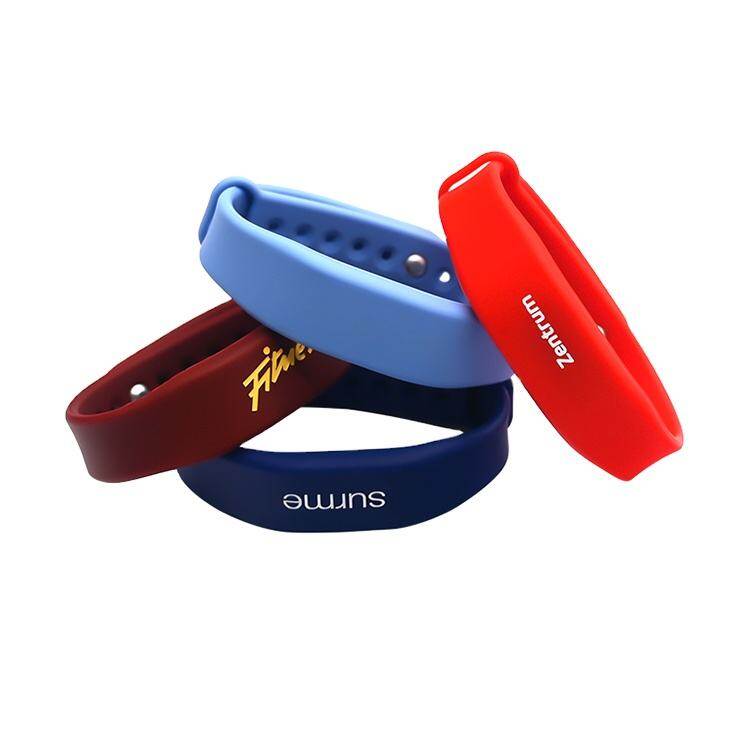
Night rounds present a dilemma that daytime care never has to confront directly. A nurse must verify that the right patient is in the right bed, that the right medication is hanging on the right pump, that the right blood unit is destined for the right arm. But the patient is asleep. Waking them to ask "What is your name and date of birth?" defeats the purpose of nighttime rest. Skipping the verification defeats the purpose of patient identification. The wristband was supposed to resolve this tension, but a barcode wristband requires light, line of sight, and often physical manipulation of the patient's arm to get a clean read.
Radio-frequency identification changes the terms of that trade-off. A passive RFID tag embedded in or attached to a patient wristband can be read without waking the patient, without turning on a light, and without the nurse breaking stride. The technology has been recommended in national patient identification guidance and is already deployed in specific high-risk scenarios, from emergency department elopement alerts to experimental trajectory-monitoring systems. But the case for RFID during night rounds is not simply about convenience. It is about whether identity verification can be made so frictionless that it actually happens, consistently, at the moments when it matters most.
The Problem with Nighttime Verification Is Not Technology. It Is Interruption.
Hospitals have well-established patient identification protocols. The standard requires two person-specific identifiers, typically full name and date of birth, verified verbally or through the wristband before any procedure, medication, or specimen collection. These protocols work reasonably well during the day, when patients are awake and can participate in their own identification.
At night, the protocol collides with the clinical priority of sleep. A patient who is woken at 2 a.m. to confirm their name is a patient whose sleep architecture is disrupted, whose delirium risk increases, whose satisfaction scores decline. Nurses know this. The result is a quiet, widespread compromise: the nurse checks the wristband by the dim light of the hallway, squints at the barcode, and if the read is difficult or the patient stirs, proceeds on the basis of the room number, the bed assignment, and the visual confirmation that this is the person who was there two hours ago.
This is not a failure of nursing diligence. It is a failure of a verification system that demands interruption as the price of confirmation. A barcode wristband requires the patient's cooperation, whether that cooperation is active (holding out an arm) or passive (not moving while the scanner finds the code). At night, both forms of cooperation are in short supply.
What Passive RFID Actually Does Differently
The technical distinction between barcode and RFID is often described as "line of sight" versus "no line of sight." That is accurate but incomplete. The more consequential distinction for night rounds is active versus passive participation.
A barcode read requires someone to point a scanner at a specific location on a specific surface and trigger a read. The scan is a deliberate act. An RFID read, by contrast, occurs when a tag enters the field of a reader. The read can be triggered by proximity, by a doorway sensor, by a handheld device carried by a nurse walking past a bed, or by an antenna mounted above the bed itself. The patient does not need to be repositioned. The wristband does not need to be exposed. The light does not need to be turned on.
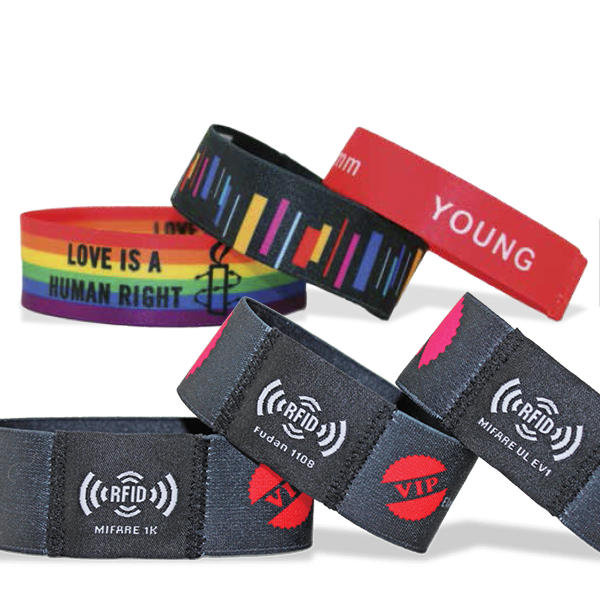
Research on passive RFID for healthcare applications confirms the technical feasibility. Passive tags operate without batteries, drawing power from the reader's electromagnetic field. They are small, low-cost, and can be embedded in wristband substrates. A 2024 systematic review of passive and battery-free RFID in medical devices notes that these systems are already used for wearable and implantable applications, with performance metrics spanning communication distance, tissue safety, and device size. The review also flags the persistent challenge: the human body itself interferes with RFID signals, and the wireless link is comparatively unsecured, raising privacy concerns that must be addressed through system architecture rather than tag design alone.
The most directly relevant evidence for night rounds comes not from a wristband study but from a patent filing for a contactless identity recognition system. The system uses RFID readers distributed across hospital areas to collect continuous spatiotemporal events from patient wristbands. The patent explicitly states that the system enables hospitals to track patient trajectories, identify risky behaviors, and verify medical order execution without manual intervention or patient contact, and that it provides data support for nighttime patrols and supervision. The patent describes the problem in terms that will be familiar to any night nurse: RFID signals are susceptible to interference from walls, metal equipment, and personnel, causing tag jitter and transient misidentification. The solution is not a better tag but a better algorithm—signal integration, dwell confidence functions, and trajectory matching that filter noise and produce a reliable identification event from imperfect reads.
The Elopement Case: RFID Already Works When Patients Cannot Cooperate
The strongest existing evidence for RFID as a non-disruptive identification tool comes from a use case where the patient is not asleep but is equally unable or unwilling to participate in verification: the high-risk emergency department patient who may wander.
Hong Kong's Hospital Authority has deployed RFID wristbands in emergency departments across the territory for patients identified during triage as high risk—those with cognitive impairment, a history of elopement, or elderly patients presenting alone. Sensors at ED exits trigger alarms at the nurse station if a tagged patient leaves the department. The clinical manager at Queen Mary Hospital, one of the pilot sites, described the selection criteria: nurses consider the patient's condition, cognitive capacity, and risk factors. Patients generally cooperate with the wristband. When an alarm sounds, staff physically respond to the location to confirm the patient's situation.

This is not the same as nighttime identity verification for a sleeping patient. But it demonstrates a crucial principle: RFID can confirm the presence and location of a patient without requiring that patient to do anything. The system reads the tag. The tag is attached to the patient. The patient's cooperation is not part of the loop. For night rounds, this principle translates directly. A reader mounted above the bed or carried by a rounding nurse can confirm that the patient in Bed 12 is the patient assigned to Bed 12 without asking Bed 12 to prove it.
The Privacy Problem Is Real and Must Be Designed Around
Any discussion of RFID wristbands that does not address privacy is incomplete, and the literature is clear that this is not a hypothetical concern. A 2020 review of RFID in healthcare notes that RFID tags respond to reader queries without alerting the tagged person, creating the potential for unauthorized access to patient records or physical tracking. The same review states that because of these privacy concerns, patient-related RFID applications are "much more complicated than asset related applications," and that the lack of industry standards and secure protocols creates a trade-off between improved patient safety and privacy risk.
The IEEE review reaches similar conclusions, noting that unsecured wireless links enabled by RFID "may also jeopardize patient's privacy as well as raise ethical concerns," and that ethical implications of RFID in healthcare have not been significantly addressed. A study of RFID use in 23 US hospitals found concerns about unfair prioritization of patients, diminished trust, and endangerment of patients.
These concerns do not invalidate the use case. They define the design requirements. The wristband should carry an identifier, not clinical data. The reader infrastructure should authenticate before granting access to the patient record. The system should log every read, creating an audit trail that makes surreptitious tracking detectable. The patient should be informed, at admission, that the wristband enables contactless identification and what that means. None of these requirements is technically difficult. They are policy choices that determine whether the system serves the patient or surveils them.
The national guidance is moving in this direction. The updated Patient Identification SAFER Guide, published in 2026, strengthens recommendations for electronic patient identification, including barcoding and radiofrequency identification on patient wristbands, and recommends biometric identification at registration and point of care. The inclusion of RFID in national safety guidance is a signal that the technology has moved from pilot to recommended practice, with the expectation that implementation will address the security and privacy concerns the literature has identified.
What Night Rounds Would Look Like: Raising Patient Identification Accuracy Without Waking Anyone
If a hospital implemented RFID-enabled contactless verification for night rounds, the workflow would change in ways both small and significant.
Before the round: The nurse reviews the assignment. The RFID reader—whether a handheld device or a fixed antenna covering a group of beds—is active. No special preparation is required.
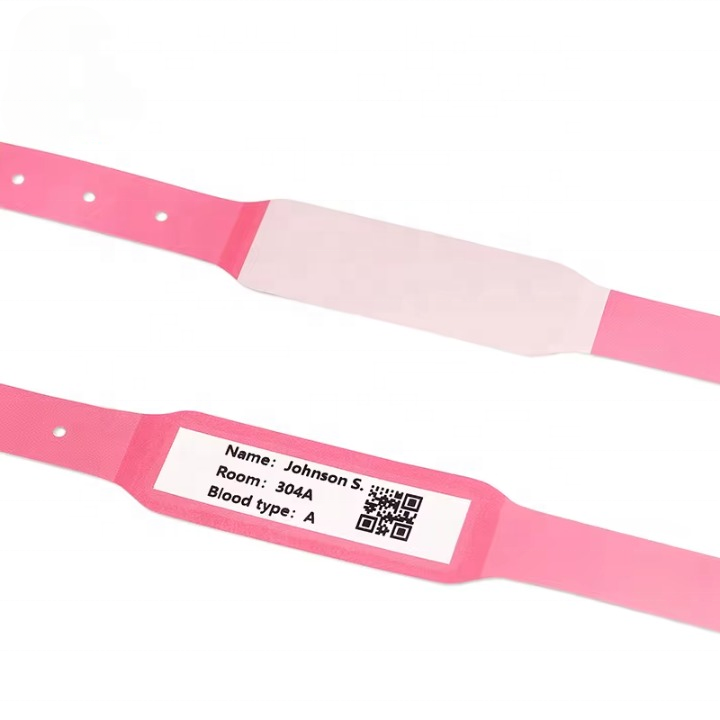
At the bedside: The nurse approaches the bed. The reader detects the wristband tag. The system matches the tag identifier to the patient record and to the current location (bed/room assignment). The read must succeed whatever the substrate: a standard adult band, one of the extended-length wristbands stocked as bariatric patient wristbands, or one of the ankle bands applied when wrist access is unavailable. If the match is confirmed, the nurse's device displays a green confirmation. If the tag is not detected, or the identifier does not match the expected patient for that location, an alert prompts the nurse to perform a manual check.
During the task: Medication administration, pump programming, or specimen labeling can be linked to the confirmed identity. The nurse does not need to wake the patient to ask their name. The verification has already occurred passively, as a byproduct of proximity.
After the round: The system logs the verification event with timestamp and location. If a patient's tag is not detected during a scheduled round—because the wristband was removed, the tag failed, or the patient is not in the expected bed—the system flags the absence for follow-up.
The critical difference from barcode-based verification is not accuracy. A barcode scan, when performed correctly, is highly accurate. The difference is completion rate. A verification method that requires waking the patient will be skipped, deferred, or performed incompletely under the pressures of a night shift. A verification method that occurs passively, without patient participation, has a much higher chance of being performed every time, for every patient, without exception—and completion rate, not theoretical precision, is what ultimately protects patient identification accuracy after midnight.
The Limits of the Technology and the Limits of the Evidence
The evidence for RFID wristbands in night rounds is not a body of controlled trials demonstrating reduced adverse events. It is a patchwork of feasibility studies, patent filings, national guidance, and single-site deployments that collectively suggest the technology can do what it claims. The Hong Kong elopement system is a real deployment, but it addresses a different problem than routine night verification. The contactless identity patent describes a sophisticated trajectory-monitoring system, but a patent is not a peer-reviewed outcome study.
What the literature does establish is that passive RFID can read tags without line of sight, that it has been recommended for patient identification by national safety guidance, and that the privacy and security challenges are known and addressable through system design. What the literature does not yet provide is a multi-site study showing that RFID-enabled night rounds reduce wrong-patient errors, improve nurse satisfaction, or measurably reduce sleep disruption.
That gap matters. Hospitals considering the investment should treat RFID-enabled night verification as a promising approach with a strong technical rationale and a limited but growing evidence base, not as a proven solution. The implementation should include evaluation metrics: verification completion rates, nurse-reported workflow impact, patient-reported sleep quality, and identification-related incident reports—the same identification-compliance indicators that CAP Q-Probes style surveillance programs track when they audit whether staff actually verify identity at the bedside.
The Wristband That Lets the Patient Sleep
The deepest problem with night rounds is not that nurses are careless. It is that the verification system was designed for a patient who is awake, cooperative, and able to participate in their own identification. A sleeping patient is none of these things. The barcode wristband, for all its utility during the day, asks the night nurse to choose between waking the patient and verifying the identity. Too often, the nurse chooses neither: they perform a partial check, rely on context, and move on.
RFID does not eliminate the need for verification. It changes the cost of verification from an interruption to a background event. The wristband becomes readable without being presented. The patient becomes identifiable without being disturbed. The nurse becomes able to confirm what the system already knows, rather than asking the patient to prove it.
That is a meaningful change. It does not solve every identification problem in the hospital. It does not replace the need for active verbal confirmation when the patient is awake and able to participate. But for the hours between midnight and dawn, when the patient's rest is part of their recovery and the nurse's time is stretched thin, a wristband that can be read without being seen—and without waking the person wearing it—is not a luxury. It is the difference between a verification that happens and one that is quietly, understandably, and dangerously skipped.
A note on terminology for readers seeking further information: This article discusses patient identification wristbands, hospital wristbands, medical ID bands, RFID wristbands, and patient ID bracelets in healthcare settings. Related terms include contactless patient verification, non-disruptive rounding, nighttime patient identification, RFID patient tracking, passive RFID healthcare, barcode wristbands, patient identification errors, wristband scanning compliance, and night shift nursing workflow.
Continue Reading
Have Questions About Wristbands?
Our team is ready to help you find the perfect wristband solution for your needs. Contact us directly on WhatsApp for quick responses.
Contact on WhatsApp